
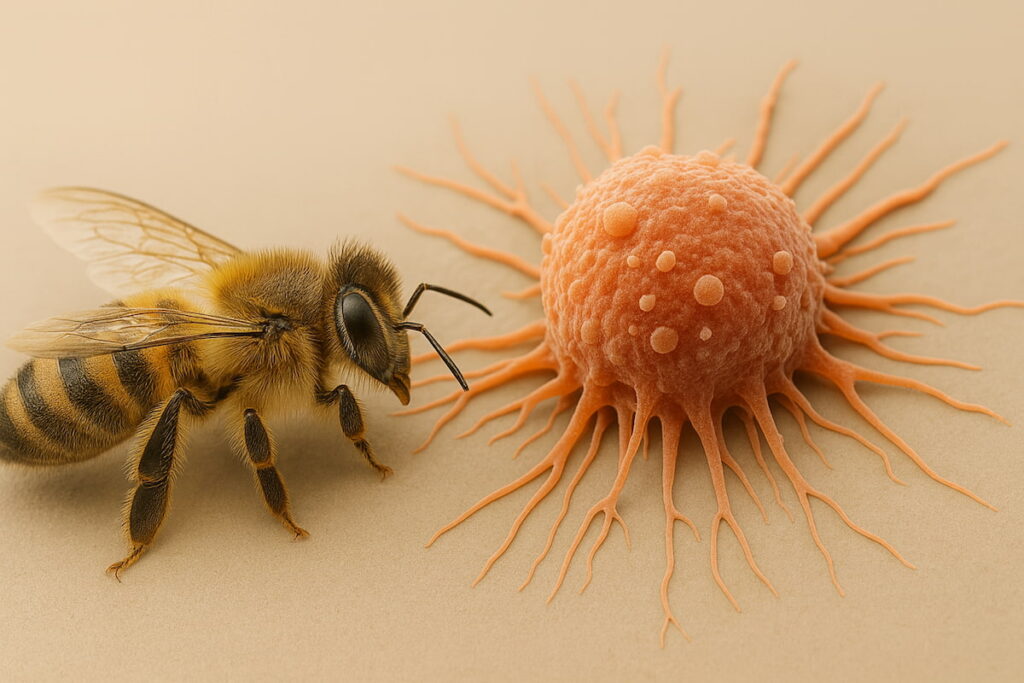
Melittin is a small peptide and the major component of bee venom. It accounts for nearly half of the dry weight of venom and is considered the major pain-producing substance of bee venom. Scientists have studied this compound for decades because of its unique ability to interact with cell membranes, influence the body’s immune system, and display both harmful and therapeutic effects.
Structure of Melittin
The structure of melittin consists of 26 amino acid residues arranged in a linear chain. This sequence gives it both hydrophobic and hydrophilic properties, which allow it to insert into a cell membrane and disrupt its stability. Researchers often classify it as a cytolytic peptide because it can create pores in the lipid bilayer and cause cells to rupture.
Effects of Bee Venom and the Action of Melittin
The effects of bee venom during a bee sting are immediate, producing pain, redness, and swelling. The action of melittin is largely responsible for this reaction. It can trigger an inflammatory response, activate pain pathways, and stimulate immune activity. This is why bee venom injection causes both pain and swelling in humans and animals.
Honeybee venom contains additional proteins such as phospholipase A2, hyaluronidase, and apamin, but it is the most studied because it drives most of the acute responses. The venom gland in the honeybee produces this compound specifically for defense.
Interaction of Melittin with Cells
The interaction of melittin with a cell membrane changes permeability and can lead to leakage of cellular contents. Researchers have found that it induced apoptosis in certain types of cancer cells, suggesting therapeutic potential when properly controlled. Laboratory studies indicate that melittin using modern delivery systems may reduce risks and allow specific targeting of tumors.
Cancer Research and Melittin
Scientists study its activity against several types of cancer cells. Research on breast cancer cells and ovarian cancer cells has shown that it can disrupt tumor growth. Studies on aggressive breast cancer subtypes such as triple-negative breast cancer and her2-enriched breast cancer cells demonstrate that it results in cancer cell death under experimental conditions.
Anti-Cancer Effect of Bee Venom
The anti-cancer effect of bee venom has been explored in prostate cancer, lung cancer cells, and gastric cancer models. Researchers found that melittin and phospholipase combinations may enhance cytotoxicity. Evidence suggests that this alone or venom and its major component together could kill cancer cells compared to melittin delivered in weaker forms.
Cancer Therapy Potential
Trials involving the injection of melittin into tumors are experimental, but early studies suggest that it can cause targeted destruction of cancer cell lines. Researchers also note that the cytotoxic effects of melittin differ between cancer and normal tissue, which creates challenges for safe use. Still, some findings indicate that it may provide a treatment of cancer when paired with delivery systems like nanoparticles.
Melittin and Breast Cancer
Studies on common cancer in women such as breast cancers suggest that melittin injection or application of bee venom may slow cancer cell growth. Laboratory work using mcf-7 and mda-mb-231 breast cancer subtypes found that it exhibited cytotoxicity. Scientists also test whether it enhances chemotherapy by weakening cancer cell membranes and increasing drug uptake.
Medical Applications Beyond Cancer
Joint and Pain Relief
Bee venom therapy has been practiced in traditional medicine for conditions such as arthritis and chronic pain. Bee venom and its main peptide melittin are applied in relief gels or bee venom-induced acupuncture sessions. Clinical studies on intraplantar bee venom show melittin up-regulates certain inflammatory pathways initially but can also reduce long-term pain through immune modulation.
Skin and Cosmetic Uses
Honey bee venom appears in personal care and cosmetic products. It has also been used in creams that claim to improve skin health, collagen stimulation, and skin rejuvenation. The properties of melittin, when combined with manuka honey or hyaluronic acid, make these items popular in anti-aging markets.
Infection and Immunity
It is a basic antimicrobial peptide. Studies show that the incorporation of melittin into ointments or gels may reduce bacterial growth. Researchers continue to test how the ability of melittin to disrupt microbial membranes can help develop new drugs.
Safety and Risks
Although it shows promise, its potency also raises concerns. The presence of melittin in high concentrations can cause pain, swelling, and allergic responses. An injection of bee venom in sensitive individuals may result in severe reactions, including anaphylaxis. For this reason, clinical trials use controlled doses and advanced delivery systems.
Scientists have shown that it is the main compound driving both positive and negative effects. While bee venom could provide therapeutic benefits, the amount of melittin must be managed carefully. Clinical studies found that it can cause harm to healthy cells when not targeted properly.
Future Directions
Advanced Delivery Systems
Future studies explore melittin using nanoparticles, polymers, or engineered liposomes. These carriers release melittin specifically into cancer cell membranes, reducing damage to normal cells.
Expanded Cancer Research
Researchers continue to investigate melittin in breast cancer treatment, prostate cancer cells, lung cancer cells, and other cancer cell lines. Trials suggest that it significantly reduces cancer cell growth, but human trials are still limited.
Biotechnology and Synthetic Melittin
Scientists develop synthetic versions and new form of melittin with reduced toxicity. Recombinant peptide melittin may provide safe and effective medical applications.
Final Thoughts
Melittin is a small but powerful peptide derived from the venom gland of the honey bee. It is the pain-producing substance of bee venom and the component of bee venom most responsible for the effects of a bee sting. While often associated with discomfort, the effect of melittin in scientific research reveals broader possibilities. Studies show that it has cytotoxic effects on several types of cancer cells, including breast cancer cells, ovarian cancer cells, and prostate cancer cells. The anti-cancer effect of bee venom in cancer therapy trials suggests that it may one day provide a treatment option.
Although melittin can cause pain and swelling, its properties also make it a candidate for future medicine. With careful delivery and continued research, melittin may move beyond being the pain-producing substance of bee venom and instead become a vital bioactive tool in healthcare and biotechnology.